Author: Ayoko

  • The Difference Between Boundaries and Walls

    The Difference Between Boundaries and Walls

    Boundaries became the word for a while. Set a boundary. Hold your boundary. Boundaries are self-care. And I do not disagree with any of that. What I have noticed, though, is that sometimes what people call a boundary is actually a wall, and the two things feel completely different on the inside.

    Understanding which one you are working with matters. Not to judge yourself, but because the path forward looks different depending on the answer.

    What a boundary actually does

    A boundary is something you set while staying in relationship. It says, in effect: I want to be here with you and I need this one thing to be different for that to keep working. It is a bid toward something better, not a door closing. Boundaries hold you in connection with other people. They make connection sustainable.

    A wall is something different. A wall says: I am not letting you close enough to reach me. It is protection through distance. And I want to be clear that there are absolutely people and situations where that distance is the only sane response. Not every door needs to stay open. Some walls were built for very good reasons and should stay exactly where they are.

    The complication is when walls get built in places where you actually want something to grow. You want closeness but intimacy feels like a trap. You want to be known but being known has gotten you hurt before. So you keep people at the exact distance where they feel safe, which is also the distance where they can never fully reach you, and you call it having high standards.

    How to tell which one you are in

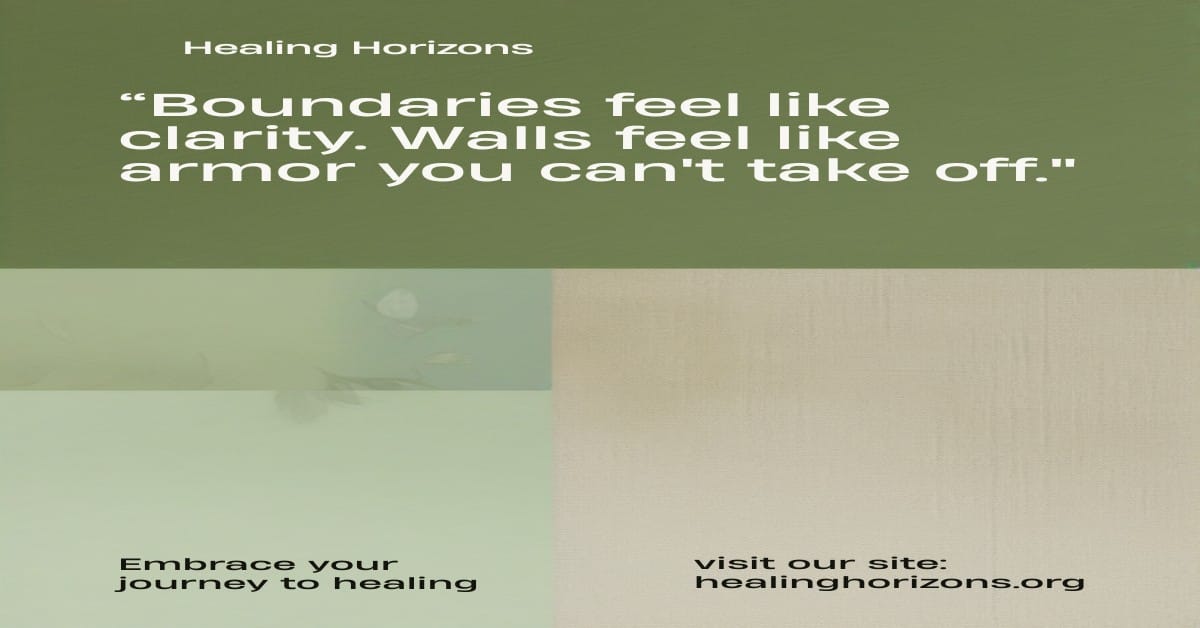
    Boundaries tend to come from knowing what you need. Walls tend to come from fear of getting hurt again. One feels like clarity. The other feels like armor you cannot take off even in the moments you want to.

    If you have described yourself as having high standards but you are also quietly lonely, that is worth sitting with. If connection has a pattern of ending right when things start to get real, that is worth sitting with. If you genuinely cannot remember the last time you let someone fully in, that is worth sitting with.

    Not because something is broken in you. But because healing asks for more than just keeping the bad things out. It also asks you to make room for good things to come in. Walls do one job extremely well. The other job, they were never designed for.

    The question is not whether your walls were necessary. They probably were. The question is whether they are still serving you now, or whether they are keeping out things you actually want.
    Related reading

  • Closure Without a Conversation: When the Door Is Already Closed

    Closure Without a Conversation: When the Door Is Already Closed

    There is a point in healing where you realize that closure is not always something that arrives through a conversation. Sometimes closure is something you give yourself by deciding the chapter is done and then actually leaving it closed.

    Someone from my past sent word, through my mother, that they wanted to reconnect. More than a year of no contact. An apology was being offered. The feeling communicated was that enough time had passed.

    I sat with that for a while before I knew what I felt about it.

    Time on its own does not rebuild trust. What time does is create distance. Trust comes back through accountability, through changed behavior, through something demonstrated rather than just expressed. An apology is not nothing. But an apology is a feeling. It is not the same as evidence of growth. And after patterns that caused real, repeated harm, a feeling does not automatically change what I know to be true about what that relationship cost me.

    Holding a boundary is not the same as holding a grudge

    A grudge is about them. It is about keeping score, about needing them to suffer, about something unresolved in you that keeps pulling your attention back.

    A boundary is about you. It limits access in order to protect something. It does not require ongoing anger. It does not require the other person to understand it or agree with it. It simply says: I know what your presence costs me, and I am choosing not to pay that price again.

    I am not angry. I do not need vindication. I do not need this person to finally see my worth or grieve what they lost. My healing is not a performance for the people who wounded me. It does not require their witness to be real.

    The thing about information traveling through other people

    What I had to see clearly was that the issue had long ago stopped being about the original relationship. The issue had become the continued flow of information that kept us connected without my consent.

    Every message passed through someone else, every update about what this person wanted or felt, reopened something I had already decided to close. I was not being asked to respond. But the effect was the same. I was still tethered to something I had walked away from, through channels I had never agreed to keep open.

    So I made a decision about what I needed. I asked that messages no longer pass between us. I became more careful about what I share in spaces where information can travel somewhere I did not send it. I stopped discussing my child, my plans, my life, in circles where those things might circle back.

    Protecting your peace sometimes means managing the flow of information around you, not just the direct relationships in your life.

    What it actually means to surrender something

    I have found that you cannot genuinely release something to God while holding onto a private plan for how it should resolve. Real surrender means letting go of the outcome entirely. The apology. The vindication. The moment when the other person finally understands what they did and what it cost you.

    That is harder than it sounds, because wanting those things is completely human. It is human to want to be understood. It is human to want someone to genuinely reckon with the harm they caused. But waiting for that reckoning before you allow yourself to move forward keeps you tied to them. It makes your peace contingent on their behavior. Which means you are not actually free yet.

    Releasing the outcome does not mean pretending the harm was not real. It means deciding that justice, understanding, and resolution belong to something larger than what you can arrange on your own, and choosing to live your full life in the meantime.

    Access is something I get to decide

    I have had to make peace with the fact that the people around me are free to maintain whatever connections they choose. I cannot control who my parents speak to. I do not want to try. Trying to manage everyone else’s relationships as a way of protecting yourself is exhausting, and it does not actually work.

    What I can control is access to me. To my child. To my home. To my life. That is not a punishment I am withholding from anyone. It is simply something I am no longer making available.

    Some people belong in your past. Not because you hate them. Because you have learned what their presence costs you and you have decided to stop paying it. That is not bitterness. That is clarity. And there is a real difference between the two.

    Healing is not about making people understand your limits. It is about respecting them yourself, consistently, even when no one is watching and even when it would be easier to just open the door again to end the discomfort of keeping it closed.

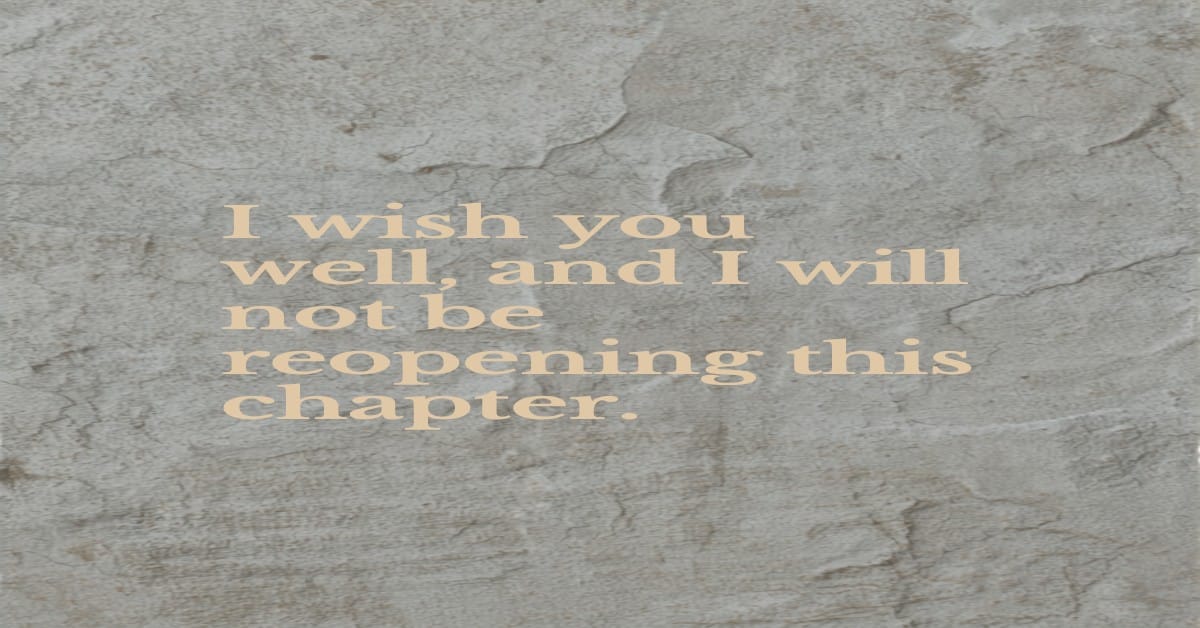
    I wish you well. I am not reopening this chapter.

    And then you keep living your life.

    Related reading

  • How to Rebuild Self-Trust After It’s Been Broken

    How to Rebuild Self-Trust After It’s Been Broken

    The hardest part about betrayal is not always what the other person did. Sometimes it is that you did not see it coming. Or you saw it coming and stayed anyway. And now something in you keeps asking: if I got that so wrong, how do I trust anything I think I know about myself?

    That question has a way of settling in quietly. You start second-guessing decisions that used to feel clear. You ask five people for their opinion before you can make a simple choice. You replay old situations looking for what you missed, as if finding the flaw in your past thinking will somehow protect you from future pain. And somewhere along the way, your own instincts start to feel like the last thing you should listen to.

    I want to offer something different here, because I have been in that place and I know how disorienting it is.

    What self-trust actually means

    We have been taught to think of self-trust as infallibility. Like if you really trusted yourself, you would never miss a red flag or make a decision that cost you something. You would see everything clearly and always choose right.

    That is not self-trust. That is the impossible standard we set for ourselves after something goes wrong so we have a reason to keep punishing ourselves.

    Real self-trust is much quieter than that. It is the belief that when things go sideways, you will be able to handle it. That you will tell yourself the truth even when the truth is hard. That you will not abandon yourself in the middle of a hard season the way someone else once did. It is having a relationship with yourself that is honest enough that you do not need constant outside validation just to feel like you are making reasonable choices.

    How you actually start to rebuild it

    Small kept promises. That is where it begins. Not the dramatic ones, the big declarations you make when you are feeling motivated. Those are easy to break and every break takes something from you. Start with something so small it almost feels pointless.

    Say you are going to bed by eleven and then go to bed by eleven. Say you are not responding to that text tonight and then do not respond to it. Tell yourself you will take a walk around the block and then take the walk. These things feel almost embarrassingly small. They are not. Every time you follow through on something you told yourself you would do, you are laying down a track record with yourself. Over time, that track record becomes something you can actually stand on.

    You also rebuild self-trust by starting to treat your own inner experience as information worth paying attention to. When something feels off, notice that instead of immediately talking yourself out of it. You do not have to act on every instinct right away. But stop dismissing them like they mean nothing. They have been trying to tell you something for a long time.

    And then there is the part that is the hardest for most of us: forgiving yourself for what you did not know when you did not know it. You made the choices you made with the information, the resources, the self-awareness, and the wounds you were carrying at the time. Holding those choices against your current self is like being angry at a child for not knowing what they had not yet been taught.

    You knew what you knew. Now you know more. That is how it is supposed to go.

    Related reading

  • When Manipulation Looks Like a Friendship

    When Manipulation Looks Like a Friendship

    Some of the most disorienting relationships are not the ones that start badly. They are the ones that start with what feels like overwhelming grace.

    The friendship moved fast. Within weeks there was daily contact, an open door, practical help offered before I even had to ask, introductions to people in her circle, and a lot of language about divine timing and purpose. At the time, I read that as genuine connection. Looking back, I can see that the speed of it never left room for trust to actually build on its own terms. And trust that does not build naturally tends to have a reason it could not.

    The signs I did not have language for yet

    Manipulation does not always announce itself. Sometimes it looks like someone who gives constantly while quietly working the room behind the scenes.

    I noticed over time that certain pieces of information found their way back to me in ways that felt designed to unsettle rather than inform. Small things, comments about what other people thought of me, observations about my choices, things said just casually enough that I could not quite land on what was actually happening. I started to feel vaguely off-balance in a way I could not explain to anyone because every individual thing had been subtle enough to dismiss.

    There was also a pattern of triangulation. She had introduced me to most of the people I met in that season, which meant she had already shaped the story of who I was before I walked into any room. I learned eventually that the version of me she presented to others was different from the one she showed to my face. By the time I met certain people, the narrative was already in place. Most people trust who they have known longer. That is human. It is also easy to exploit.

    The projection piece

    She talked a great deal about other people in her life: how controlling they were, how difficult, how obsessive. Over time I started to notice that the qualities she described most vividly in others were the ones most present in how she moved through the world herself. That is a pattern worth knowing. People who have not done their own work often describe themselves most accurately when they think they are describing someone else.

    There was also something underneath the surface of many of our conversations that I can only describe as a kind of competitive grief. The people in her life who had stable marriages or financial peace or settled lives were spoken about with a particular edge. I did not understand it for a long time. When I finally did, it helped me stop taking her behavior personally. She was carrying something unresolved, and some of it was landing on me.

    The part that was hardest to sit with

    Someone can genuinely help you and simultaneously resent you. I had to learn that those two things are not contradictions. A person can be practically generous while also engaging in patterns that are quietly harmful. Recognizing the harm does not require you to erase the help. Both things happened. Both were real. Holding that complexity is part of what makes this kind of relationship so hard to process, because nothing is clean enough to be simple.

    I also had to accept that acting with integrity does not protect you from becoming someone else’s target. I communicated honestly throughout that friendship. I gave the benefit of the doubt more times than I probably should have. I refused to speak negatively even when I had reason to. None of that was enough to change what was happening. Good intentions are not armor.

    What I learned to trust instead

    I learned to pay attention to patterns rather than isolated moments. One kind gesture does not define a relationship. One act of generosity does not cancel out a consistent pattern of behavior that leaves you confused, anxious, and always slightly on the defensive.

    Healthy relationships feel like solid ground. You do not have to spend energy managing someone’s perception of you or justifying your reactions or explaining yourself every time you express a feeling. When a relationship consistently produces confusion and self-doubt, that is not a coincidence. That is information.

    I do not carry anger about that time anymore. Distance has a way of making visible what closeness conceals. What I carry instead is a much clearer sense of what I am looking for and what I am no longer willing to accept. That clarity was expensive. But it was worth the cost.

    Related reading

  • Signs Your Nervous System Is Stuck in Survival Mode

    Signs Your Nervous System Is Stuck in Survival Mode

    There is a version of survival mode that is obvious. Something happened. The ground shifted. You know you are not okay and you can point to exactly why.

    Then there is the other kind. The one that has been running so quietly in the background that you stopped questioning it years ago. You just started believing this is who you are. This is your personality. This is simply how you are built.

    That second one is what I want to talk about. Because it is the one that gets missed the most, and it is the one that shapes almost everything.

    What it actually looks like

    You walk into a room and before you even say hello, something in you is already scanning. You clock the mood of whoever is there. You look for the shift, the tension, the thing that might need to be managed. You do this in a split second without deciding to. It just happens.

    The tiredness is the one I could write a whole essay about on its own. Because this kind of tired does not go away with sleep. You can get eight solid hours and still wake up feeling like you have been running all night. Your body has been on alert for so long it never fully drops into rest. Sleep happens but recovery does not. Your system stays on even when you are unconscious.

    Stillness feels wrong. Not just boring, actually wrong. The moment you have nothing to do, something in you reaches for the phone, for a task, for noise. Quiet has a way of letting everything you have been outrunning catch up, and somewhere in your body you learned a long time ago that feelings were not safe to feel. So you keep moving.

    Your reactions feel scrambled sometimes. You can lose it over something small and then go completely still in an actual emergency. From the outside it looks inconsistent. But it makes its own kind of sense when you understand that your system is calibrated to old danger, not current reality. It is responding to a threat that may not even exist in the room anymore.

    And then there is the waiting. Even when things are genuinely good, you cannot settle into them. Something in you holds back, stays braced. Like some part of you already knows this will not last, so you might as well stay ready for when it falls apart. You are never quite present for the good things because you are already preparing for their ending.

    People-pleasing shows up here too, and this is the one that took me the longest to understand. When you grew up in an environment where other people’s moods determined your safety, accommodation stops being a choice and starts being a strategy. Disagreement does not just feel uncomfortable. It feels like danger. That is not a personality trait. It is a nervous system doing the only thing it knew how to do to keep you safe.

    This is not a character flaw

    Nothing on this list means something is fundamentally wrong with you. It means your body learned what it needed to learn to get you through something hard. That was smart. It worked. The difficulty is that those same strategies tend to follow you into environments where they are no longer needed, and your system does not automatically know the difference.

    You also cannot think your way through this. I wish you could, because thinking is something a lot of us are good at. But the nervous system does not move based on logic. It moves based on feeling safe, on repetition, on your body slowly being shown over time that it can exhale. That kind of change is slower than we want it to be. But it is real, and it is possible.

    Your baseline is not set in stone. It just requires a different kind of attention than most of us were ever taught to give ourselves.

    Related reading

  • When They Told You That You Were Too Much

    When They Told You That You Were Too Much

    One of the most damaging things you can tell a child is not that you do not love them. It is that they are too much.

    Because being told you are unloved is devastating, but a child can sometimes locate the problem in the other person. Being told you are too much places the problem squarely inside you. Your energy is too big. Your feelings take up too much space. Your needs are exhausting. Your voice is too loud. Your excitement is showing off. And over time, a child does not just hear that message. They become it. They start editing themselves down before anyone else has to ask them to.

    What shrinking does to a person over time

    A child who is consistently told they are too much does not simply become humble. They disconnect from themselves. They stop reaching for things. They learn to pre-emptively quiet their voice, pull back their joy, dim whatever it is about them that seemed to bother people. They practice making themselves smaller, not because they want to, but because at some point smaller started to feel safer.

    And then they carry that into adulthood. They sit in meetings and do not speak even when they know the answer. They do not ask for what they need because asking feels like being a burden. They apologize for taking up space in rooms they were invited into. They have a hard time receiving a genuine compliment without immediately deflecting it, because deep down some part of them is still waiting for someone to tell them they are getting too big for themselves again.

    Who finds us in that state

    People with a solid sense of their own worth tend to move toward relationships that are mutual. People who have been taught to question their worth tend to move toward relationships where someone else defines their value for them, because that pattern feels like home.

    Controlling people, emotionally immature people, people who need someone small so they can feel large, they find us. Not always on purpose, and not always consciously. But they recognize the wound. Someone who has already learned to doubt themselves is much easier to keep in place, because they have been practicing it their whole lives.

    And the cruelest part is that a lot of survivors experience those relationships as confirmation of what they always believed about themselves. When really, those relationships are just repeating the lesson that was first taught at home.

    Where it actually starts to shift

    It starts when you question the original message instead of accepting it as fact.

    Who told you that you were too much? What did they actually stand to gain from you believing it? Were they someone with the emotional capacity to hold your full self, or were they someone who found your confidence, your light, your potential, threatening? Because those are two very different things and only one of them says something true about you.

    Most of the people who taught us we were too much were not responding to our actual character. They were responding to their own discomfort. Their limitations became our instructions. And we have been following instructions that were never meant to lead us anywhere good.

    For me, faith was part of this

    I will be honest about this because it is part of my story. Learning to see myself through God’s eyes rather than through the eyes of people who misunderstood me changed something foundational for me. My worth stopped being a thing I had to earn or prove or carefully maintain. It became something I stood in because of whose I am, not because of how small I had managed to make myself to fit inside someone else’s comfort zone.

    When your sense of identity shifts at that level, your decisions shift with it. You stop accepting treatment that once felt normal because it no longer lines up with how you understand yourself. You stop chasing validation from people who were never equipped to give it. The story that you were too much starts to lose its grip, and what you find underneath it is someone who was never the problem to begin with.

    You were not too much

    Healing is not about becoming someone new. It is about finding your way back to the person you were before the world convinced you to become less.

    You were not too much. You were in the wrong rooms, around the wrong people, at a time when you did not yet have the tools or the language or the freedom to choose differently. That is not a character flaw. That is just what happened. And it does not have to be the whole story.

  • What Soft Strength Actually Means

    What Soft Strength Actually Means

    When I started this project, someone asked me if “soft strength” was a contradiction. Like the two words were working against each other and one of them had to give.

    I sat with that for a while before I responded, because I understood why the question made sense.

    Most of what we have been taught about strength is that it looks like not needing anything. Not breaking down. Being the one who holds the room together even when you are falling apart inside. We learned early that softness was something to outgrow, something that made you easy to take advantage of, something that other people used against you when they wanted to.

    So the idea that soft and strong could live in the same body, at the same time, feels almost too good to be true for a lot of us.

    But what I have come to understand is that the loudest, hardest, most defended version of strength is often the most fragile one. Because it depends on nothing getting through. And life always finds a way through.

    What soft strength actually is

    It is not about being pleasant or agreeable or easy to be around. It is not about turning the other cheek when someone keeps hurting you. And it is not something you perform for other people so they see you as healed.

    Soft strength is what happens when you know yourself well enough that you do not need the world to confirm your worth before you can feel okay. It is the ability to pause before you react and actually choose how you want to respond. It is saying no to something and not spending the next three days apologizing for it in your head. It is letting someone love you without immediately waiting for the moment it goes wrong.

    It is knowing the difference between your intuition and your anxiety. And trusting the right one.

    That kind of knowing does not come from nowhere. It comes from doing the kind of work that nobody else can see. The kind you do in the quiet, when you finally stop running from yourself long enough to be honest about what is actually going on inside you.

    Why it is gentle

    Soft strength is not gentle because it is weak. It is gentle because it is secure. There is a difference, and once you feel it, you cannot unfeel it.

    Security does not have to prove anything. It does not have to fight for the last word. It does not collapse when someone is disappointed in it. It can hold space for hard conversations without becoming the hardness itself.

    That is what this project is about. Everything here is built around helping you find your way to that kind of grounded, quiet, real power. Not overnight. Not through a list of steps you check off and then declare yourself done. But through the slow, honest work of actually learning to trust yourself again.

    That work is possible. I know because I am in it too.

  • You Do Not Need to Forgive in Order to Heal

    There is a lot of pressure placed on forgiveness in healing spaces. As if it’s the finish line. As if something is wrong with you if you’re not ready or if you never get there.

    I want to say this plainly:

    You do not need to forgive someone in order to heal.

    For many people, especially those recovering from emotional abuse, chronic invalidation, or long-term survival stress, forgiveness gets pushed far too early. And it often comes at a cost.

    Healing is not about moral performance.
    It’s about safety. Clarity. Self-trust.


    Why Forgiveness Gets Complicated After Trauma

    When someone has repeatedly crossed your boundaries, distorted your reality, or kept you in a state of emotional vigilance, your body adapts.

    That isn’t bitterness.
    That’s protection.

    Being told you must forgive in order to “move on” can quietly recreate the same dynamic that caused harm in the first place: your inner experience being set aside so someone else can feel comfortable.

    Trauma healing isn’t about overriding your instincts.
    It’s about understanding why they formed.

    Forgiveness is often used to rush past grief. Past anger. Past truth.
    Sometimes it bypasses accountability altogether.
    Sometimes it asks the person who was harmed to carry more emotional responsibility than the person who caused the harm ever did.

    That isn’t healing.
    That’s self-abandonment dressed up as virtue.


    What Healing Actually Looks Like

    Healing requires honesty. It requires naming what happened without minimizing it. It often means rebuilding trust with yourself long before trust with anyone else is even on the table.

    For many people, healing looks like:

    • Distance, not reconciliation
    • Clarity, not closure
    • Regulation, not forced peace
    • Boundaries, not access

    You can let go without rewriting history.
    You can stop carrying someone else’s harm without absolving it.

    You can stop bleeding without pretending the wound never existed.


    If Forgiveness Comes, It Comes Or It Doesn’t

    Some people arrive at forgiveness naturally, after safety has been restored. Others never do. Both outcomes are valid.

    Forgiveness is not a prerequisite for healing.
    It is not a requirement.
    It is not proof of growth.

    Your nervous system does not need forgiveness to settle.
    It needs consistency. Safety. Self-respect.

    Healing is allowed to be slow.
    It’s allowed to be quiet.
    And it’s allowed to center you.

    That is soft strength.

    Related reading

  • What Is the Soft Strength Project?

    The Soft Strength Project is a trauma-informed space for women who are rebuilding their lives after burnout, emotional trauma, or prolonged pressure. This work centers nervous-system awareness, self-trust, and grounded personal power without hustle, forcing, or toxic positivity.

    Why Soft Strength Matters

    Many women are taught to survive by staying strong, pushing through, or silencing their needs. Over time, this creates burnout, disconnection, and self-doubt. Soft strength is the ability to stay regulated, discerning, and grounded while still choosing growth, boundaries, and change.

    What You’ll Find Here

    The Soft Strength Project offers reflections, education, and practical tools for nervous-system regulation, emotional clarity, boundary-setting, and rebuilding self-trust. This space is not about fixing yourself or becoming someone else. It’s about returning to yourself in a grounded, sustainable way.

    • Trauma-informed reflections and writing
    • Nervous-system-aware tools and education
    • Guidance on boundaries, discernment, and self-trust
    • Slow, grounded rebuilding after burnout or emotional overwhelm